Home
About Pets at Home
Our Services
Our Team
Our Rates
Contact us
Photo Album
Information
Links
Help
E-mail
Tel: 0823041767
Fax: 0866983651
Skype

Pets at Home - Gauteng South Africa - Petcare Information

Stop your puppy from nipping - Part 4 of 5

3. The Nose Tap

If your puppy nips turn to him immediately and give him the “sit” command. Take your forefinger and hold it up in front of his nose, then tap him on the nose and say “no bite” in a stern tone of voice. It’s important to note two things here: 1) the nose tap isn’t designed as a dire punishment - you’re not trying to hurt him, but rather startle him into stopping the behavior; and 2) your tone of voice is just as important as the nose tap. Don’t scream at him - your voice should be stern and give a clear warning - think of it as a verbal growl - something that he can understand as a dog. An interesting result of this manner of breaking this habit is that down the road, when your puppy has learned to recognize the raised finger – he’ll usually stop whatever behavior he’s engaging in just because he knows what’s coming. You won’t even have to raise your voice - just lift that finger.

4. Don’t encourage biting or nipping in the first place

Don’t let the kids start “chase” games - that encourages dogs to think that the kids are prey. Don’t play games that involve waving your hands in front of your dog and encouraging him to jump or nip. Don’t play tug-of-war with your dog - it will not only encourage him to think he’s your equal, it can promote nipping if you use a rope toy, for example, because he’ll try to bite at your hands to make you lose your grip on the toy. Play games of fetch and retrieval, but be sure that your dog knows the “drop” or “release” command so you’re not fighting over the toy.

Click here to see part 5 of 5.

If you any questions or comments please call me on Tel: 0823041767 or e-mail me.


Pet Care - Greater Johannesburg Area - Taking care of your pets and home while you are away. info@petsathomecc.co.za

BIRDS - LOVEBIRDS

BIRDS - LOVEBIRDSLovebirds - We're More Than Just Friends.

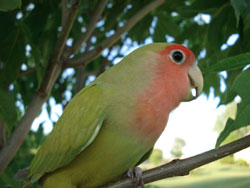
If we see two people out in public and they appear to be affectionate, like holding hands or even kissing, there's usually a term we use to describe their behavior. The term we use is lovebirds, because they appear to be in love. But those people really are imitators, because the real lovebirds are birds. A lovebird is a type of parrot. Their name comes from the fact that they are very sociable and affectionate. When they bond with their mate, it usually lasts their entire life. Though it's possible to have only one, it's best to keep the birds in pairs.

The lovebird is short and stocky. It's considered to be one of the smallest parrots in the world. Though many lovebirds are green, they can come in many colors. The average life span of a lovebird can be anywhere between 10 to 15 years. There are 9 different species, so how can we know the difference? They can be identified by their colors and markings; each species has their own unique color scheme.

Lovebirds were basically unknown until the 1600s. Some Europeans, touring Africa, saw the birds and decided to write about them. The first lovebirds were imported into Europe in the 19th century but by the 20th century, many were being imported into both Europe and the US.

The lovebird can be found in Africa and in Madagascar. It prefers a dry and open area. The lovebird can lay between 3 to 6 eggs at a time and it usually takes about 22 days for the eggs to hatch. The baby birds generally leave the nest within 5 weeks of being born. When in the wild, lovebirds like to live in small flocks. Their diet consist of grass, seeds, fruit and vegetables.

Lovebirds are popular pets. Breeding lovebirds is a big business. Though some owners may have lovebirds from the wild, most are purchased through breeders. The lovebirds that come from the breeders are more tame and should probably adapt to their new environment, easier then lovebirds from the wild. Pet owners need to be sure they want lovebirds as their pets. If the owners only want one bird, then they need to know that a lovebird requires a lot of attention and interaction. That's why it's suggested that lovebirds be kept in pairs, so they can keep each other company. Lovebirds, just like humans, sometimes don't get along.

Owners need to make sure their birds are compatible, because if they're not, they will fight.

The lovebird is one of those exotic birds that has been able to adapt to domestication much easier than most other creatures from foreign countries. They make great pets, as long as the owners understand all that is involved with owning them. Maybe it's their social ability or the chirping that makes the lovebird such a desirable pet. People love having something foreign and exotic to liven up their homes and show off to their neighbors. Lovebirds have created a large and loyal following in the world of pet owners. 

Copyright - 2000 - 2007 by [Webcraft.ws]. All rights reserved.
Revised: 24 Nov 2007 07:15:15 +0200.