| 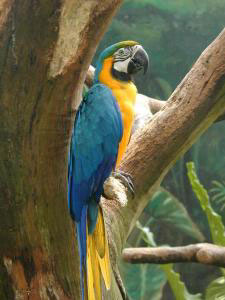 Blue And Gold Macaw Of The Rainforest. Blue And Gold Macaw Of The Rainforest.
The blue and gold macaw of the rainforest is found mainly in tropical South America. Bolivia, Brazil, Ecuador, northern Paraguay, and eastern Peru all offer the kind of home the macaw parrot needs. The blue and gold macaw's natural habitat includes open marshlands and woodlands, but the rainforest, with its large trees is a favored habitat.
Blue and Gold Macaw Population Density
The blue and gold macaw of the rainforest is an endangered species. Because of hunting, trapping for the pet trade, and destruction of their habitat, blue and gold macaws are gradually disappearing from the rainforest, as well as other areas.
Habitat destruction appears to be the greatest danger to blue and gold macaw population density. Logging, in particular, removes the largest trees - the ones macaws favor for nesting. Without suitable nesting sites, the blue and gold macaw of the rainforest is doomed to extinction.
Perhaps the second greatest danger to the blue and gold macaw is the pet trade. Traders climb trees to remove chicks from their nests. If climbing is too difficult, trees are felled, and chicks who survive the fall are taken. Few survive to maturity, rapidly decimating their numbers.
Blue and gold macaws are usually seen in pairs or family groups. At times, they may be seen in flocks of a dozen or so. Sadly, such sightings are becoming increasingly uncommon. The blue and gold macaw population density in the wild is already much lower than the numbers in captivity. Some put the total of those in the rainforest at no more than 200 pairs.
Coloring
The blue and gold macaw of the rainforest is almost entirely bright aqua blue and golden yellow. The wings are tipped with a bright true blue. Since both male and female look identical, breeders must use a blood test or DNA test to determine gender. The blue and gold macaw has a creamy white face, with distinctive black feather lines and green forehead.
Size
A full-grown blue and gold macaw is one of the largest parrots in the world.
■ Length - Male: 34-36 inches
■ Length - Female: 32-34 inches
■ Weight - Male: 2-2 3/4 pounds
■ Weight - Female: slightly smaller
■ Wingspan - Male: 41-45 inches
■ Wingspan - Female: slightly smaller
Temperament
Of all the parrots of the world, the blue and gold macaw is said to have one of the mildest, most easy-going temperaments. Unlike some parrot species, the blue and gold macaw is willing to interact with various family members rather than being a one-person bird. It will, however, prefer one above the others.
Extremely intelligent, a blue and gold macaw can be taught both to talk and to do tricks. It mimics human words loudly and clearly. It is a very expressive bird, showing what it wants by cocking its head, flashing its eyes, and "talking" to you. It may also fluff its feathers, bow, bob its head, and prance around.
A blue and gold macaw can become very tame and playful if hand-raised. They will always require a lot of attention, though. If they become bored, they can be very destructive.
Toys
Give a blue and gold macaw wood to chew, and he will forget about chewing things that are off-bounds. This parrot keeps its beak in good condition by chewing wood. It also relieves pent up energy by chewing wood. As a result, it chews very aggressively.
A variety of stimulating chew toys will keep it from becoming bored.
Food
The blue and gold macaw of the rainforest usually eats bark and leaves, fruits, nuts, seeds, and vegetables, but it will also eat small animals in the wild. It visits clay licks to get mineral supplements into its diet, and to detoxify seeds.
In captivity, a blue and gold macaw will eat fresh pellets or seeds. It will need fresh fruits and vegetables daily, with old ones discarded after 24 hours. It will need a ready supply of fresh, clean, chlorine-free water, too. The blue and gold macaw appreciates quality and variety in its food, and may let you know if it is not happy about what it receives. |
 info@petsathomecc.co.za